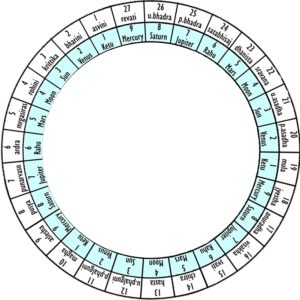
 In Vedic astrology, the Moon (Chandra) attains its fullest interpretive depth through the Nakshatra system, a lunar zodiac of 27 (sometimes 28) stellar divisions. While the rāśi (sign) system reflects broad psychological and temperamental tendencies, the Nakshatras provide a micro‑cosmic, phenomenological, and karmic mapping of the mind. Because the Moon governs manas—the perceptual, emotional, and cognitive apparatus—the Nakshatra occupied by the Moon at birth (Janma Nakshatra) is considered one of the most significant determinants of personality, behavior, and life experience in classical Jyotiṣa.
1. Conceptual Foundations of the Lunar Mansions
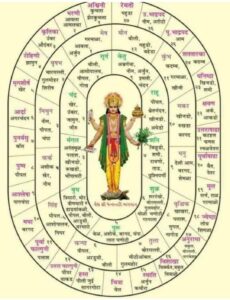
The Nakshatras represent fixed stellar sectors of 13°20′ each, forming a sidereal framework that predates the twelve‑sign zodiac. Their origins lie in Vedic ritual astronomy, where lunar phases and stellar alignments regulated sacrificial timing, agricultural cycles, and calendrical structure. The Moon’s rapid movement—traversing one Nakshatra approximately every 24 hours—makes it the primary luminary for measuring daily psychological states, emotional rhythms, and experiential patterns.
Each Nakshatra is defined by:
- A presiding deity (devatā) representing archetypal forces
- A shakti (power or capacity) describing its functional essence
- A symbol that encodes its mythic and psychological themes
- A planetary ruler (Nakshatra lord) shaping its behavioral expression
This multi‑layered structure enables a nuanced interpretation of the Moon’s placement.
2. The Moon as the Psychological Lens of the Nakshatras
 Because the Moon signifies emotion, memory, attachment, and subjective experience, its Nakshatra placement reveals:
- Cognitive style (how one perceives and processes reality)
- Emotional regulation patterns
- Instinctive responses and behavioral tendencies
- Attachment style and relational orientation
- Subconscious motivations and early conditioning
The Janma Nakshatra is also foundational for:
- Dasha calculations (Vimshottari system begins from the Moon’s Nakshatra)
- Naming conventions (traditional syllables assigned to each Nakshatra)
- Muhurta (electional astrology)
- Psychological compatibility (Guna Milan in marriage analysis)
Thus, the Moon’s Nakshatra functions as a psychological signature within the natal chart.
3. Structural Groupings and Their Interpretive Value
a. By Gana (Temperament Classification)
Nakshatras are divided into:
- Deva (divine) — gentle, harmonious, sattvic
- Manushya (human) — practical, adaptive, rajasic
- Rakshasa (asuric) — intense, assertive, tamasic
The Moon’s placement in these groups indicates baseline emotional disposition and interpersonal style.
b. By Guna (Sattva–Rajas–Tamas Cycles)
Each Nakshatra embodies a triadic cycle of:
- Sattva (clarity, harmony)
- Rajas (activity, desire)
- Tamas (inertia, obscuration)
This cycle shapes the Moon’s mental orientation and motivational structure.
 c. By Purushartha (Life‑Purpose Orientation)
Nakshatras align with the four aims of life:
- Dharma (duty, ethics)
- Artha (material stability)
- Kama (desire, pleasure)
- Moksha (liberation)
The Moon’s Nakshatra reveals the dominant existential drive underlying emotional behavior.
4. Deity and Myth as Psychological Archetypes
Each Nakshatra’s presiding deity provides a mythic template for interpreting the Moon’s functioning. For example:
- Rohini (Brahma) — creativity, growth, sensuality
- Ashlesha (Nagas) — depth, secrecy, psychological complexity
- Swati (Vayu) — independence, movement, adaptability
- Anuradha (Mitra) — friendship, loyalty, social harmony
These deities serve as archetypal frameworks through which the Moon expresses its emotional and cognitive patterns.
5. The Moon’s Strength and Vulnerability Across Nakshatras
Certain Nakshatras enhance the Moon’s natural qualities:
- Rohini — considered the Moon’s most auspicious placement
- Hasta — clarity, skill, emotional intelligence
- Shravana — receptivity, learning, social awareness
Others challenge or intensify its psychological expression:
- Ardra — emotional turbulence, transformative experiences
- Ashlesha — intensity, psychological depth, potential volatility
- Mula — deconstructive tendencies, karmic purification
These placements do not imply “good” or “bad” outcomes but rather distinct psychological trajectories.
6. The Moon–Nakshatra Matrix as a Karmic Indicator
The Moon’s Nakshatra is often interpreted as a karmic imprint, reflecting:
- Early childhood conditioning
- Emotional memory patterns carried from past experiences
- The individual’s habitual mode of engaging with the world
- The psychological lessons central to this lifetime
In this sense, the Moon’s Nakshatra functions as a bridge between personal psychology and karmic narrative.
Conclusion
The Moon’s placement in the Nakshatra system represents one of the most sophisticated interpretive tools in Vedic astrology. It integrates astronomical precision, mythological symbolism, psychological insight, and karmic philosophy into a single analytical framework. As the luminary most closely tied to human emotion and perception, the Moon’s Nakshatra offers a uniquely detailed understanding of the individual’s inner world, behavioral patterns, and existential orientation