The Sun, or Surya, occupies a central position in Vedic astrology as the primary significator of the Atman—the individual soul, consciousness, and essential identity. As the most authoritative of the Navagrahas, the Sun symbolizes vitality, illumination, and the governing principle that sustains life. Its astrological role extends beyond physical light to encompass psychological structure, moral orientation, and the individual’s capacity for self-realization.
1. Symbolic and Conceptual Framework
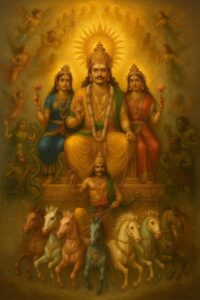
In classical texts, the Sun is associated with the fire element, sattvic qualities, and masculine energy. It is traditionally linked with gold, the color red, and Sunday as its day of influence. Anatomically, it governs the eyes, heart, and overall vitality, reflecting its role as the source of life and perception. The mythic image of Surya riding a chariot drawn by seven horses is interpreted as representing the seven days of the week or the seven chakras, emphasizing the Sun’s regulatory and harmonizing functions.
2. Core Astrological Significations
The Sun is the principal indicator of:
- Identity and ego-structure
- Vitality, immunity, and physical resilience
- Authority, leadership, and governance
- Career, reputation, and public standing
- Father and paternal influences
- Moral purpose (dharma) and self-direction
A well‑placed Sun is associated with confidence, clarity of purpose, and the ability to exercise leadership. Conversely, an afflicted Sun may manifest as diminished self-esteem, health vulnerabilities, or difficulties with authority figures.
3. Psychological and Physiological Influence
Psychologically, the Sun represents the organizing principle of the personality—the capacity for willpower, self-discipline, and coherent identity formation. It governs one’s sense of autonomy and the ability to act with intention. Physiologically, it is linked to the heart, circulatory vitality, and ocular strength, reflecting its role as the central life-giving force.
4. Mythological Context
Vedic literature identifies Surya as the son of Kashyapa and Aditi, and the father of significant figures such as Shani (Saturn), Yama, and Karna. Ritual practices associated with Surya—such as Surya Namaskar, Sandhyā Vandana, and the recitation of the Gayatri Mantra—underscore his role as a deity of illumination, discipline, and moral clarity. These narratives reinforce the Sun’s association with righteousness, duty, and cosmic order.
5. Zodiacal Influence

The Sun rules the sign Leo and is exalted in Aries at 10°, where its qualities of initiative, courage, and self-assertion are most pronounced. It remains in each zodiac sign for approximately one month, and its placement in a natal chart indicates the domain of life in which an individual seeks recognition, expresses authority, and develops a sense of purpose.
6. The Sun as Atmakaraka
The Sun is regarded as the Atmakaraka, the planet holding the highest degree in the chart and thus representing the soul’s primary karmic lesson. When functioning as Atmakaraka, the Sun emphasizes themes of identity, integrity, and the pursuit of one’s essential truth. A strong Sun in this role aligns the individual with their dharmic path, while a weakened Sun may indicate struggles with self-definition or ego integration